

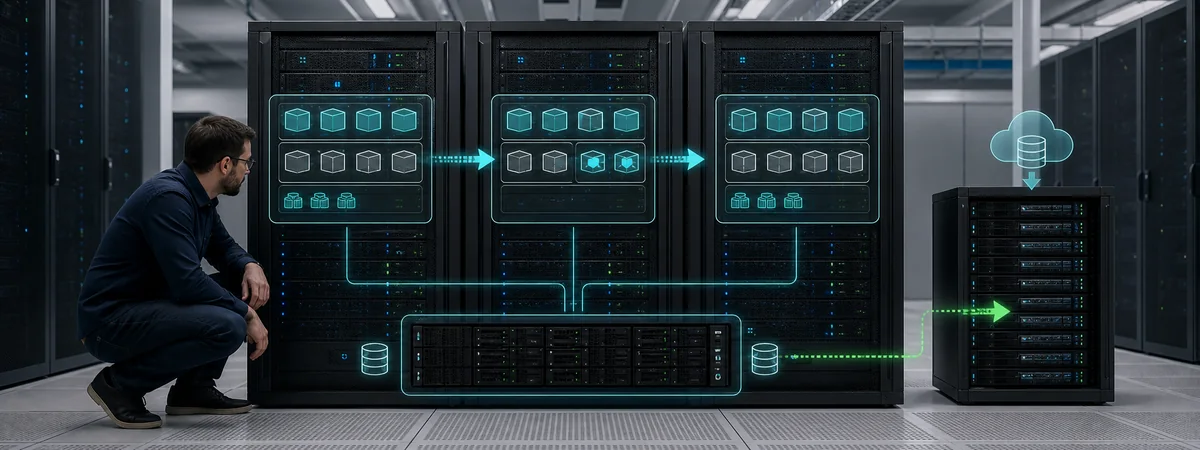
Virtual machines, containers, quorum, storage, protection and operations
What Is Proxmox VE? Cluster, Storage and Backup Guide
Proxmox VE combines KVM virtual machines, LXC containers, software-defined storage and cluster management in one open virtualisation platform.
Review Your Proxmox PlanShort definition
Proxmox VE is a virtualisation management platform for KVM virtual machines and LXC containers
Proxmox Virtual Environment provides a web interface, API and command-line tools for managing compute, network, storage, clusters, high availability, backup jobs and access control. KVM provides full virtual machines with their own guest operating systems, while LXC provides operating-system-level containers that share the host kernel. A useful production design still requires compatible hardware, reliable cluster networking, planned storage, protected management access and tested recovery.
Core concepts
Six areas determine whether a Proxmox design is operable and resilient
KVM virtual machines
Full virtual machines support diverse guest operating systems and stronger workload isolation at the cost of more resource overhead.
LXC containers
System containers are efficient for compatible Linux workloads but share the host kernel and need a different security and support assessment.
Cluster and quorum
Corosync and the replicated configuration system coordinate nodes. Majority quorum protects cluster consistency during network partitions.
Network architecture
Management, cluster, migration, storage, guest and backup traffic need capacity, redundancy and security appropriate to their roles.
Storage and replication
Local ZFS, shared storage, Ceph and other backends differ in performance, failure domains, complexity and migration capability.
Backup and recovery
Backups must be stored outside the failure domain, retained, monitored and restored through an agreed application validation process.
Cluster design
Quorum prevents unsafe cluster changes, but it does not replace network and failure-domain planning
A Proxmox cluster distributes configuration and uses quorum so that a partitioned minority cannot continue making conflicting changes. A stable cluster therefore needs a reliable, low-latency Corosync path and a node count or quorum device design appropriate to the topology. Stretching a cluster across unsuitable links can turn a connectivity issue into an availability problem.
Cluster traffic is only one network role. Management, guest, live migration, storage and backup can create very different load and security requirements. VLAN separation, redundant switches, bonding, MTU consistency, routing and firewall policy are designed together. Physical power, rack and upstream storage dependencies are also recorded so three nodes do not hide one shared failure point.

Architecture decision
Six stages from workload inventory to an accepted Proxmox platform
-
01
Workload and dependency inventory
Virtual machines, operating systems, resources, applications, databases, licences, integrations and service importance are recorded.
-
02
Capacity and host design
CPU, memory, storage, interfaces, expansion, hardware support, maintenance capacity and node-loss headroom are calculated.
-
03
Cluster, network and storage plan
Quorum, traffic separation, switching, storage backend, replication, migration and failure domains are documented.
-
04
Protection and security baseline
Administrative identity, roles, updates, management access, firewall, backups, encryption keys and monitoring are defined.
-
05
Pilot migration and failure tests
Representative workloads validate performance, compatibility, live or offline migration, node failure, backup and restore.
-
06
Handover and lifecycle plan
As-built records, versions, subscriptions, alert ownership, maintenance, capacity reviews and upgrade sequence are assigned.

Migration and recovery
A successful virtual machine migration is not complete until backup and restore are proven
Migration planning checks source hypervisor, virtual disk formats, guest drivers, firmware mode, network mapping, licensing, snapshots, application quiescence and acceptable downtime. Each workload receives a method, maintenance window, validation owner and rollback condition. The highest-risk business system is not used as the first test.
Proxmox backup jobs or Proxmox Backup Server can protect virtual machines and containers, but copies still need independent capacity, retention, access protection, monitoring and recovery tests. Encryption keys are stored separately from the backup they protect. Restore validation includes the guest boot, network identity, application, database consistency, credentials and business transaction, not only a completed restore task.
Decision record
What a Proxmox architecture review should produce
Workload and capacity matrix
Current resources, growth, criticality, compatibility, dependencies and recommended host placement.
Cluster and quorum design
Node roles, votes, Corosync path, failure behaviour, maintenance assumptions and split-brain controls.
Network and storage map
Traffic roles, switches, bonds, VLANs, MTU, storage backend, performance and redundancy.
Security and access baseline
Identity, roles, MFA where applicable, management exposure, firewall, updates, repositories and audit responsibilities.
Backup and recovery plan
Targets, retention, encryption, off-platform copies, monitoring, RPO, RTO and restore acceptance.
Migration and test plan
Workload sequence, method, downtime, rollback, driver checks, failure tests and customer validation owners.
Useful planning input
Information needed for a Proxmox review
- Current workloads
- VM and container list, operating systems, CPU, memory, disks, applications, databases, licences and criticality.
- Hardware and network
- Host models, controllers, drives, interfaces, switches, VLANs, uplinks, racks, power and expected growth.
- Storage and protection
- Current storage, snapshots, replication, backup products, targets, retention, restore history, RPO and RTO.
- Migration objective
- Source platform, timeline, downtime limits, support model, security constraints and internal application owners.
Frequently asked questions
What Is Proxmox VE? FAQ
What is the difference between a KVM virtual machine and an LXC container?
A KVM virtual machine emulates hardware and runs its own guest operating system. An LXC container shares the Linux host kernel and isolates processes and resources at operating-system level. Compatibility, isolation, backup and support requirements differ.
Does Proxmox VE require shared storage for a cluster?
Not for every cluster function. Nodes can use local storage, while migration and high-availability behaviour depend on the storage and replication design. Shared storage, ZFS replication and Ceph provide different capabilities and operating complexity.
Why is quorum important in a Proxmox cluster?
Quorum requires a majority of votes for cluster state changes. During a network partition it prevents separated node groups from making conflicting decisions. Quorum does not fix a weak cluster network, shared power or storage failure.
Is Ceph required for Proxmox high availability?
No. Ceph is one distributed storage option. The correct design depends on node count, capacity, network, performance, failure domains, team skills and recovery objectives. Other shared or replicated storage approaches may be suitable.
Does a Proxmox snapshot replace a backup?
No. A snapshot usually depends on the same platform or storage and is useful for short-term rollback. A backup is a protected recoverable copy with independent retention and restore procedures, ideally outside the production failure domain.
Can Proxmox planning and migration support be provided across Turkey?
Yes. Assessment, architecture, configuration review and migration planning can be delivered remotely across Turkey. On-site work is planned where hardware, network, storage or physical migration tasks require it.
Official Proxmox references
- Proxmox VE Administration Guide
- Proxmox VE Cluster Manager documentation
- Proxmox VE backup and restore documentation
Technical review date: . Product capabilities, supported versions, licences and service boundaries are rechecked during project design.
Review Your Proxmox Architecture Before Migration
Share the current hosts, virtual machines, storage, network, backup design and service objectives. We can identify cluster, capacity, recovery and migration decisions before production changes.