


Clusters, workloads, security, data protection and operating responsibility
What Is Kubernetes? An Enterprise Planning Guide
Kubernetes automates the desired state of containerised workloads across a cluster, but production success depends on architecture, application readiness and an operating model.
Assess Kubernetes ReadinessShort definition
Kubernetes is a control system for running and maintaining containerised workloads across a cluster
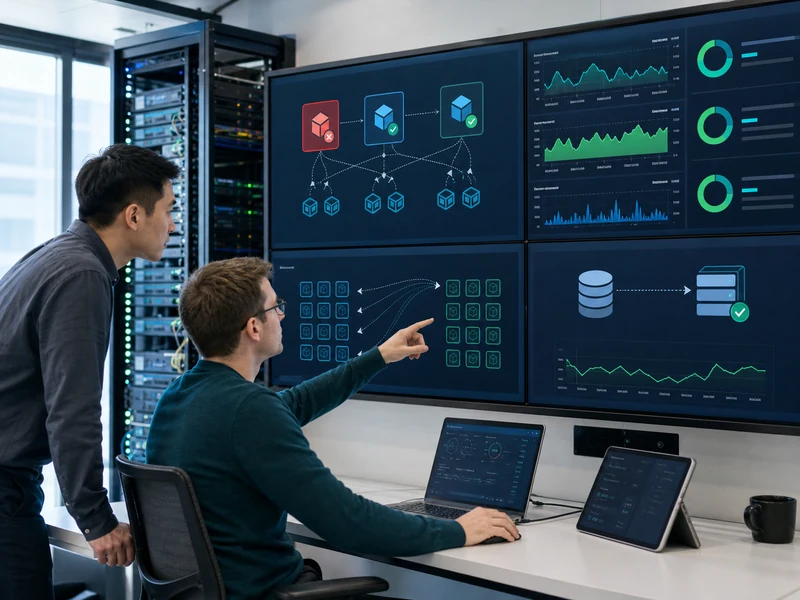
A Kubernetes cluster has a control plane that stores and reconciles the desired state, plus worker nodes that run application workloads. Applications are normally described through resources such as Pods, Deployments, Services, configuration and storage claims. Controllers continuously compare the declared state with the observed state and take action, for example starting a replacement Pod. Kubernetes provides orchestration mechanisms; it does not automatically supply a secure application, resilient storage, a tested backup or an operations team.
Core concepts
Six technical areas explain most Kubernetes architecture decisions
Control plane
The API server, cluster state, scheduling and controllers coordinate desired state. Availability and protected administrative access must be designed.
Worker nodes and Pods
Nodes provide compute capacity. Pods are the smallest deployable units and are normally managed by higher-level workload controllers.
Services and ingress
Stable service discovery, load distribution and external entry paths connect changing Pods to users and dependent systems.
Configuration and secrets
Application configuration, credentials and certificates need controlled sources, access, rotation and deployment behaviour.
Persistent storage
PersistentVolume, StorageClass and application-consistent protection connect stateful workloads to storage with known performance and failure behaviour.
Policy and observability
RBAC, Pod security, network policy, image controls, logs, metrics, traces and alerts make the platform governable and supportable.
Security boundaries
RBAC, workload controls and network policy protect different parts of the platform
RBAC controls which authenticated users and service accounts may call Kubernetes API operations. It should follow least privilege, use named identities and avoid broad cluster-level bindings without a justified owner and review date. Secret objects also need protection through restricted access, encryption and an appropriate external secret lifecycle where required.
Workload security addresses privileged containers, root use, host access, Linux capabilities, image provenance and admission decisions. NetworkPolicy can restrict Pod traffic when the selected network plugin enforces it, but required DNS, monitoring and platform flows must be tested. Node operating systems, registries, ingress, storage and external identity remain part of the security boundary.

Adoption decision
Six questions should be answered before a production Kubernetes pilot
-
01
Why is orchestration needed?
Identify application count, release frequency, scaling, portability, resilience or governance needs that simpler platforms do not meet.
-
02
Are the applications ready?
Check health endpoints, graceful shutdown, external configuration, horizontal replicas, state, licensing and deployment automation.
-
03
Who will operate the platform?
Assign ownership for cluster, network, identity, storage, security, observability, backup, upgrades and application support.
-
04
Which deployment model fits?
Compare managed cloud, on-premises and hybrid options by control, data location, skills, cost, connectivity and shared responsibility.
-
05
How will failure be contained?
Design control-plane, worker, network, storage and power failure domains together with capacity for maintenance and node loss.
-
06
What will the pilot prove?
Define measurable release, rollback, performance, security, recovery and operating-effort outcomes for a representative workload.
Resilience and recovery
High availability and backup are demonstrated through controlled failure and restore tests
Multiple control-plane or worker nodes do not remove a shared switch, power source, load balancer or storage dependency. Workload replicas need scheduling rules, disruption budgets and enough spare capacity to restart elsewhere. Stateful services additionally depend on storage replication, fencing and application consistency. Each failure domain is therefore mapped and tested.
An etcd snapshot protects important cluster state, but it is not a complete backup of application databases, persistent volumes, external secret stores or managed services. Recovery plans separate cluster configuration from application data and define restore order, credentials, target infrastructure, RPO, RTO and validation. Metrics, logs and traces then show both platform health and the effect on the business service.
Decision record
What a Kubernetes readiness assessment should produce
Workload suitability matrix
Application dependencies, state, release needs, constraints, business importance and recommended migration order.
Target architecture
Deployment model, environments, nodes, network, ingress, identity, registry, storage and failure domains.
Security baseline
RBAC, workload restrictions, network policy, secrets, image controls, audit and administrative access.
Operating responsibility matrix
Named owners for platform, application, network, security, storage, backup, monitoring and incident response.
Protection and recovery plan
Cluster state, application data, retention, off-platform copies, restore order, RPO, RTO and test schedule.
Pilot acceptance plan
Deployment, scaling, rollback, failure, security, observability, cost and recovery scenarios with measurable results.
Useful planning input
Information needed for a Kubernetes readiness review
- Application portfolio
- Technologies, dependencies, databases, stateful components, release frequency, scale and business criticality.
- Current platform
- Servers or cloud, virtualisation, network, identity, storage, backup, CI/CD, registry and monitoring tools.
- Service objectives
- Availability, performance, data location, security, compliance, RPO, RTO and support coverage.
- Team capability
- Platform, development, network, security and operations roles, experience, on-call model and training needs.
Frequently asked questions
What Is Kubernetes? FAQ
Are Kubernetes and Docker the same thing?
No. Container tooling builds and runs container images. Kubernetes coordinates containerised workloads across a cluster, including placement, desired state, networking, configuration and lifecycle. A Kubernetes environment still uses a compatible container runtime on its nodes.
Does every company need Kubernetes?
No. A small number of stable applications or a team with limited platform capacity may be better served by virtual machines, a simpler container service or managed application hosting. The operational benefit must justify the added platform complexity.
Does Kubernetes automatically provide high availability?
It provides mechanisms for replicas, rescheduling and declarative state, but availability still depends on control plane, node capacity, network, storage, power, application design and failure-domain separation. These must be tested.
Where does Kubernetes store persistent application data?
Persistent workloads use volumes provided through storage integrations and StorageClasses. The Pod lifecycle and storage lifecycle can be separate, but performance, replication, snapshots, application consistency and backup remain design responsibilities.
Is an etcd snapshot a complete Kubernetes backup?
No. It protects important cluster state. Application databases, persistent volumes, external secrets, registries and managed services require their own protection and restore process. Recovery order and credentials must also be documented.
Can Biga Bilisim help evaluate Kubernetes across Turkey?
Yes. Architecture and readiness guidance can be provided remotely across Turkey. On-site infrastructure work is planned when servers, networks, storage or facility conditions require physical verification.
Official Kubernetes references
- Kubernetes documentation: cluster components
- Kubernetes documentation: Pods
- Kubernetes documentation: storage concepts
Technical review date: . Product capabilities, supported versions, licences and service boundaries are rechecked during project design.
Assess Whether Kubernetes Fits Your Workloads
Share the application portfolio, release process, availability goals, data requirements and current infrastructure. We can identify the decisions and operating capabilities required before a pilot.