

Cat6, Cat6A, fibre, racks and documented testing
Structured Cabling Company in Antalya
Biga Bilisim plans copper and fibre infrastructure for offices, hotels, factories, warehouses, campuses, retail sites and agricultural facilities. Pathways, PoE demand, rack capacity, acceptance testing and future growth are defined as one deliverable scope.
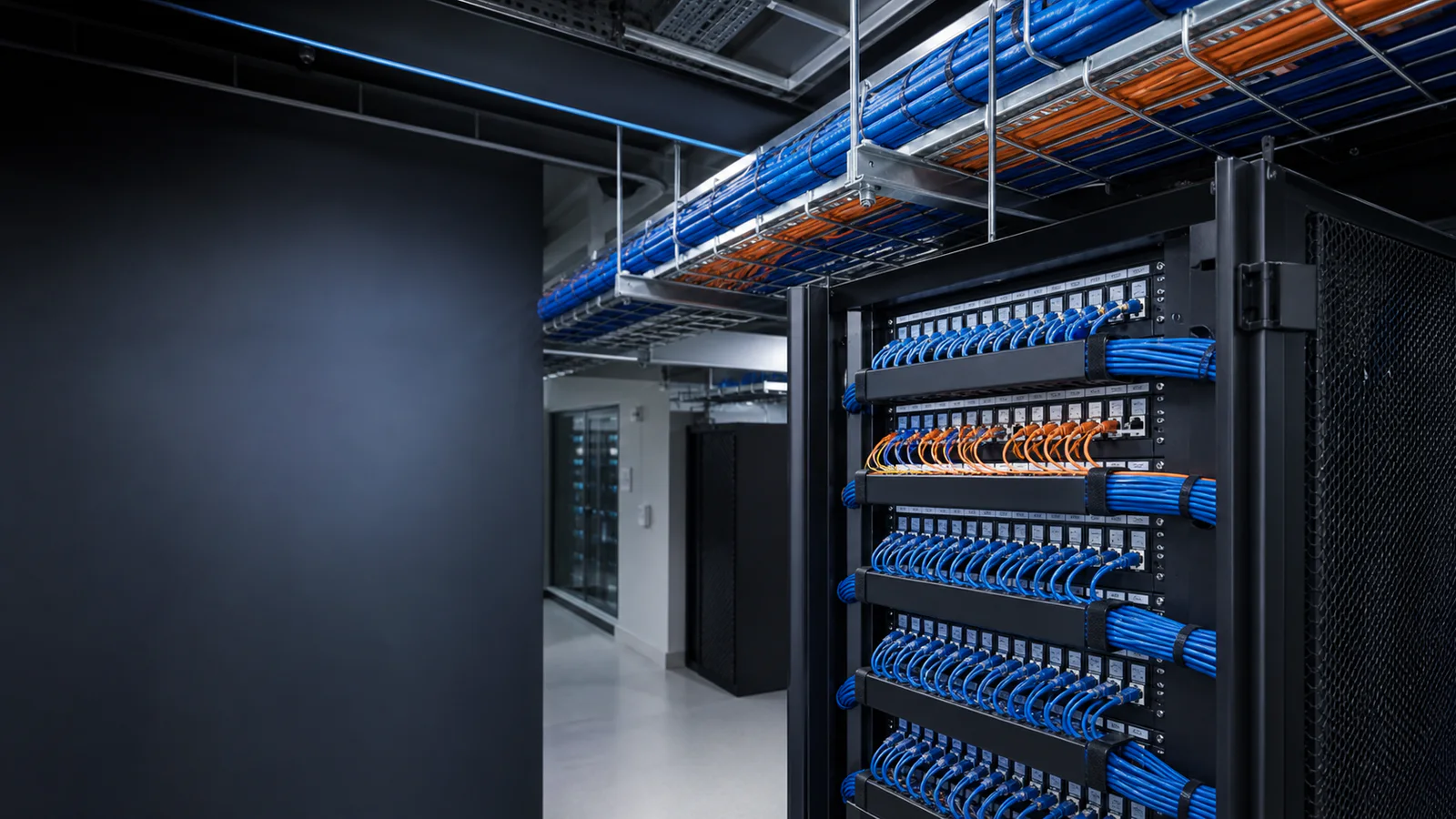
Send Your Project DetailsStructured cabling becomes maintainable infrastructure when pathways, copper and fibre backbones, racks, labelling, testing and handover records are designed together. Representative visual.
Direct answer
What is structured cabling and why does it matter?
Structured cabling is the coordinated system of cables, connection hardware, racks, pathways, identifiers and test records used by data, voice, Wi-Fi, IP cameras, access control, IoT and other IP-based services. A well-delivered system does more than establish connectivity. It identifies every link, reduces fault-isolation time, makes device replacement predictable and leaves controlled capacity for change. A cable that passes traffic is not automatically a documented, maintainable installation that meets the intended category or class.
Media and capacity decision
Cat6, Cat6A and fibre solve different parts of the infrastructure plan
Price per box of cable is not the decision model. Distance, bandwidth, PoE load, electromagnetic conditions, pathway capacity, expected service life and acceptance criteria are reviewed together.
CAT6
General user access
Cat6 can be suitable for many one-gigabit desktop, phone, printer and basic IP-device links. Whether an existing Cat6 link can support a higher-rate application depends on length, installation quality and measured performance.
CAT6A
10 Gigabit and demanding PoE
Cat6A is normally the stronger long-term choice for new installations that require full-channel 10GBASE-T, high-performance wireless uplinks or dense four-pair PoE. Cable diameter, bend radius, pathway fill and bundle temperature need to be designed from the start.
FIBRE
Backbones, distance and isolation
Fibre is used between floors, buildings, field racks and high-capacity aggregation points. Singlemode or multimode selection depends on distance, transceiver type, target speed, loss budget, spare cores and the expected upgrade path.
CommScope describes Cat6A as a 10 Gigabit Ethernet cabling option for channels up to 100 metres and positions it for Wi-Fi 6/6E/7 and four-pair PoE applications. Final design still depends on the selected system’s current technical data and actual installation conditions.
Service scope
More than cable pulling, with clear responsibility boundaries
Copper horizontal cabling
Cat6 or Cat6A cable, patch panels, jacks, outlets and patch cords are selected as an end-to-end system with distance and pathway limits.
Fibre backbones
Singlemode or multimode cable, ODFs, pigtails, adapters, splice trays, fusion splicing, optical loss and spare-core policy are shown in one schedule.
Racks and technical rooms
Rack height and depth, power, UPS, ventilation, patch panels, cable managers, switch placement, bonding and maintenance access are coordinated.
Pathways and cable tray
Fill ratio, supports, bend radius, electrical separation, fire penetrations, sharp edges and spare capacity are reviewed before installation.
Wi-Fi, cameras and PoE endpoints
Access points, cameras, phones and access-control devices receive a recorded endpoint, PoE class, switch-power allowance and maintenance-access plan.
Labelling, testing and records
Both ends use the same identifier, and outlets, patch panels and switch ports are reconciled. The required verification, qualification or certification report is written into scope.
Measurement and acceptance
A working link is not the same as a certified link
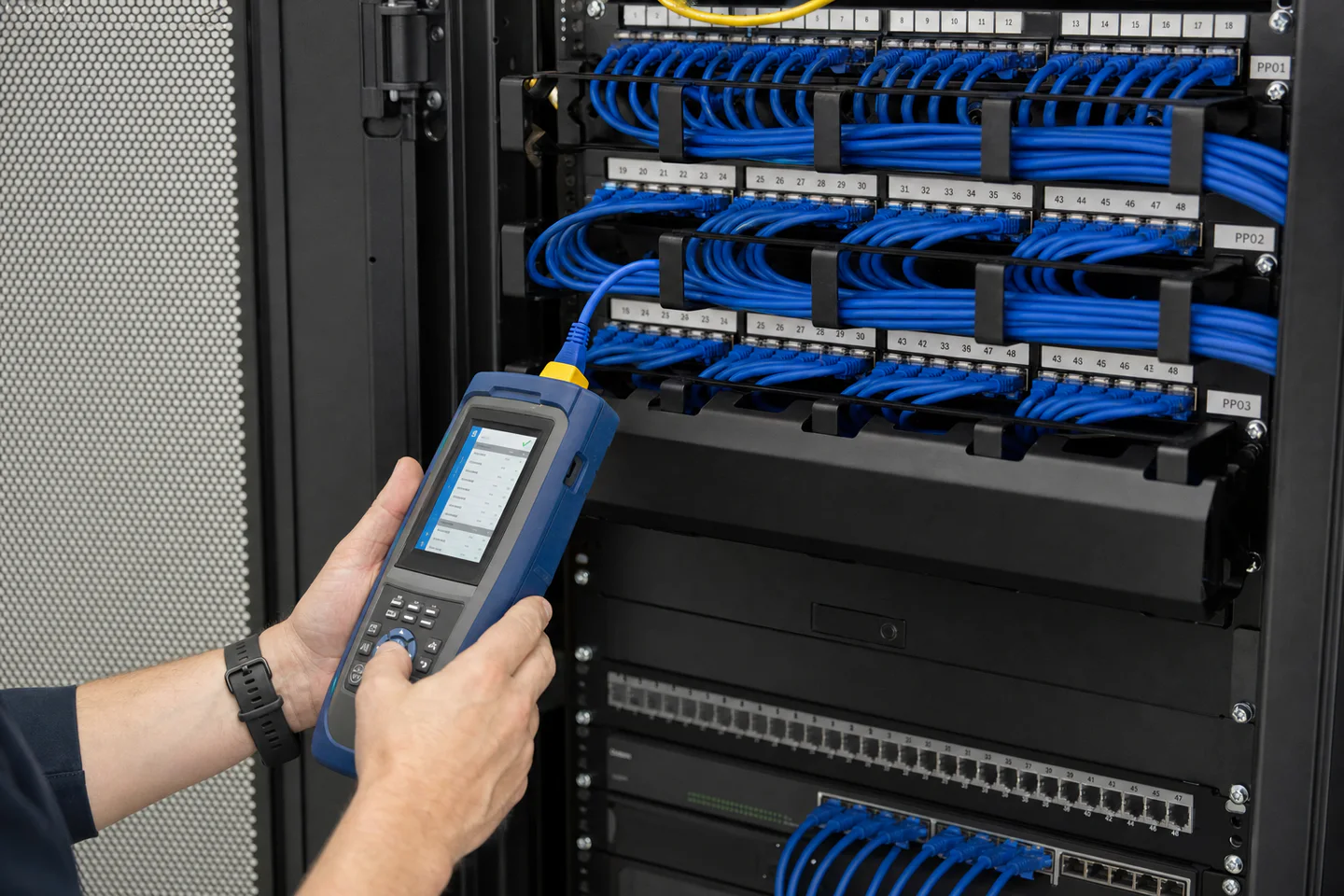
Verification tools can identify continuity, wire-map, length, opens and shorts. Qualification estimates whether a link can support a particular network technology. Certification performs more rigorous measurements against a defined TIA or ISO limit and produces acceptance records. Fluke Networks treats these as different test levels. For permanent-link acceptance, the fixed installed cabling is evaluated separately from user patch cords.
Test plan
The link model and report format matter as much as the tester
Copper wire-map and length
Pair sequence, opens, shorts, reversals, split pairs and estimated length support basic fault checks but do not constitute standards-based certification.
Permanent-link certification
The fixed link is measured with the correct adapter and selected category limit. Failed links are corrected and retested before final acceptance.
Fibre loss measurement
A light source and power meter evaluate total link loss, including splices and connectors, using the correct reference method for the agreed link model.
OTDR investigation
An OTDR locates length, splice, connector, bend and reflection events. An OTDR trace does not automatically replace end-to-end loss measurement in every acceptance plan.
Quotation note: “Testing included” is not a complete specification. State the category or fibre type, channel or permanent-link model, test limit, coverage, tester capability, output format and retest process for failed links.
Delivery process
Six controlled stages from survey to as-built records
- 01
Requirements and current state
User, device and service counts are collected with existing cables, racks, shafts, fault history, performance issues and growth expectations.
- 02
Site survey and pathways
Distances, ceiling and floor access, trays, power routes, fire compartments, working height, site safety and outage limits are verified.
- 03
Design and bill of materials
Cat6, Cat6A or fibre media, outlets, patch panels, racks, ODFs, pathways, spare capacity, labelling and test level are documented.
- 04
Installation quality control
Pulling tension, bend radius, cable bundles, terminations, electrical separation, fire stopping and physical protection are checked during the work.
- 05
Identification and testing
Every link receives one identifier at both ends. Outlets and patch panels are reconciled, agreed tests are run, and failed links are corrected.
- 06
Handover and change control
Port lists, result files, photographs, rack layouts, fibre schedules, open items and as-built topology are delivered with a method for recording later changes.
Operating environments
The same cable category does not create the same project at every site
Hotels and tourism
Guest floors, Wi-Fi, IPTV, IP telephony, cameras, door systems, public areas and round-the-clock operation shape rack distribution and phased outages.
Manufacturing and industrial sites
EMI, dust, heat, machinery, high ceilings, production stops and IT/OT separation influence pathways, shielding, fibre and physical protection.
Offices and headquarters
User density, meeting rooms, access points, phones, printers, cameras and growth plans are translated into outlet, rack and switch-port capacity.
Warehouses and logistics
Long distances, racking, handheld terminals, cameras, doors and vehicle movement may require fibre-fed field racks and carefully planned PoE.
Agriculture and greenhouses
Humidity, temperature, UV, chemicals, outdoor routes, remote buildings and lightning exposure affect product selection, fibre isolation and enclosure protection.
Multi-site organisations
A shared labelling, port-list, testing and handover template allows a central IT team to manage faults and capacity consistently across branches.
Maintainable handover
A tidy rack matters, but accurate records and service access matter too
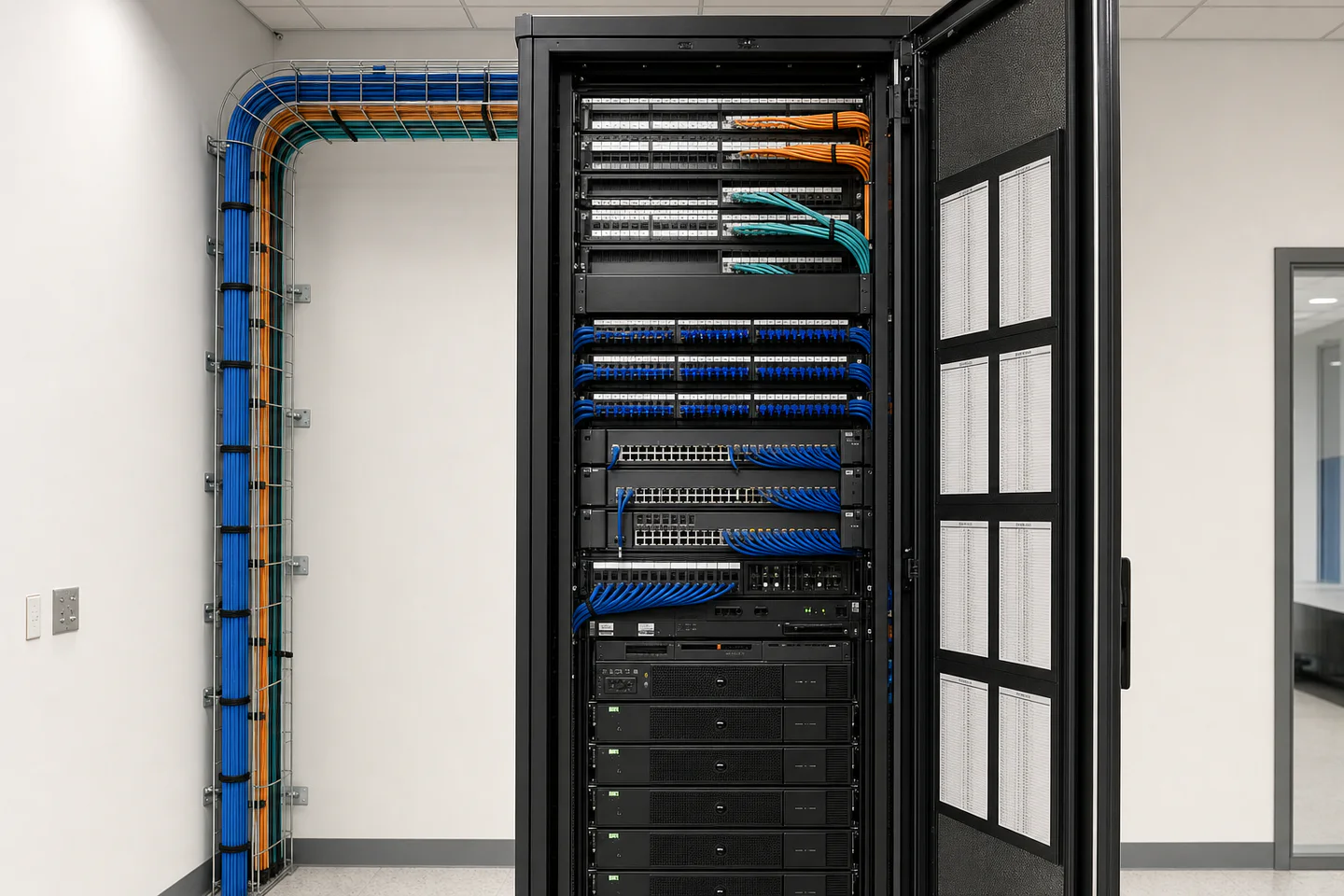
Cable managers, patch panels, switches, power, fibre trays, UPS equipment and ventilation access are arranged so that routine service remains practical. A label is not just a number on a cable. The room or endpoint, outlet, patch-panel port and preferably the switch port should form one identifier chain. If later changes are not reflected in drawings and port schedules, an initially organised system quickly becomes uncertain.
Comparable proposals
The same outlet count does not mean the same scope
A comparable proposal states the product system and category together with pathways, penetrations, racks, labels, testing, access equipment, out-of-hours work, removals and handover documents. Biga Bilisim separates construction, electrical work, statutory design, active-device configuration and manufacturer system-warranty requirements when they are outside the agreed service.
- Endpoints and use
- Location, device type, speed and PoE demand
- Pathways
- Length, tray, conduit, risers, penetrations and height
- Technical acceptance
- Category, link model, test limit and report format
- Handover
- Labels, port list, drawings, photographs and open items
Service area
On-site delivery across Antalya and project-based work in Turkey
Surveys and installations can be planned in Muratpasa, Kepez, Konyaalti, Dosemealti and Aksu, as well as Kemer, Serik and Belek, Manavgat, Alanya, Kas, Kumluca, Finike, Demre, Elmali, Korkuteli, Gazipasa and other Antalya districts. Factories, warehouses, retail chains, hotels and branch projects elsewhere in Turkey can use a common material, labelling, testing and handover standard.
Frequently asked questions
Structured cabling, testing and handover questions
What information is needed for a structured cabling quotation?
The first review needs the site location, floor plans, outlet quantities and intended use, rack locations, copper and fibre backbone requirements, PoE devices, working hours, access conditions, existing cabling records and the required test-report level. A site survey is then used to verify routes, distances, fire compartments, risers, ceiling access, electrical separation and expansion needs. A reliable quotation cannot be based on outlet count alone.
Should a new installation use Cat6 or Cat6A?
The choice depends on target applications, link length, Wi-Fi access points, PoE load, cable bundle conditions, available pathways, electromagnetic environment and expected service life. Cat6 can be suitable for many one-gigabit access links. Cat6A is normally the stronger new-build choice when 10GBASE-T over the full standard channel, high-performance wireless uplinks or demanding four-pair PoE applications are part of the plan. The selected components and installation must operate as one category-rated system.
Can existing network cables be reused?
Existing cabling can be assessed, but its colour or printed category is not enough evidence. We review routes, length, terminations, pair integrity, patch panels, outlets, previous alterations, physical damage, electromagnetic exposure and the applications the link must support. Verification or qualification may be enough for fault finding, while a formal standards-based acceptance requires the agreed certification test. Unidentified or mixed-category links should not be represented as newly certified infrastructure.
What is the difference between channel and permanent-link testing?
Permanent-link testing evaluates the fixed installed cabling between its defined connection points and excludes user equipment cords. Channel testing includes the complete operational path with patch cords within the channel model. The test limit, adapter type and configuration must match the link being accepted. Using a channel adapter for a permanent-link acceptance can produce a report that does not prove the intended fixed installation.
Does every installed cable receive a certification report?
Only when certification and report delivery are included in the agreed scope. Basic continuity or wire-map checks are not the same as standards-based certification. The proposal should state the category or class, link model, test limit, tester capability, calibration expectations, retest process, file format and whether every link or a defined sample will be tested. Failed links should be corrected and retested before final acceptance.
How are Wi-Fi access points, cameras and PoE devices planned?
Device location, data rate, PoE class, cable length, cable bundle temperature, switch power budget, pathway capacity and maintenance access are reviewed together. Wireless access point placement should follow a coverage and capacity design rather than a convenient ceiling position. Camera and access-control links also need a documented endpoint, switch port, VLAN ownership and power requirement. Cabling alone does not replace active-network or wireless design.
What documents are provided at handover?
The agreed package can include a rack elevation, patch-panel and outlet schedule, cable identifiers, route notes, fibre core schedule, test-result files, failed-and-corrected link records, photographs, equipment list, open-items register and an as-built topology. The exact package is stated in the proposal. Drawings and labels should reflect the final installation rather than the first design revision.
Do you provide structured cabling outside central Antalya?
Yes. Surveys and installations can be planned across Muratpasa, Kepez, Konyaalti, Dosemealti, Aksu, Kemer, Serik and Belek, Manavgat, Alanya, Kas and other Antalya districts. Multi-site projects elsewhere in Turkey can be reviewed separately. Travel, accommodation, working-hour restrictions, access equipment and local coordination are shown separately when they affect the commercial scope.
How can an international company request a quotation?
Send the site address, drawings, expected outlet and device counts, rack locations, copper and fibre requirements, target completion date and requested test standard to sales@bigabilisim.com. You can also call +90 532 595 04 99. We separate materials, installation, pathways, testing, documentation, access equipment, travel and optional active-network work so the proposal can be evaluated clearly.
Technical sources: CommScope Cat6A fact file · Fluke Networks test levels · Fluke Networks permanent-link definition
Technical content reviewed on 25 July 2026. Standards, product capabilities and project conditions can change; current manufacturer documents, contract requirements and site conditions are checked again before quotation and installation.
Request a structured cabling survey and quotation
Send the drawings, estimated endpoint count, rack locations and target completion date. We will define copper, fibre, pathways, testing and handover records as one clear commercial scope.